Feng Shui House-Hunting Checklist: What to Check Outside
A practical feng shui checklist for viewing a home: what to check on a satellite map before you go, what to confirm on site, and which classical form-school feature each item comes from.
In brief
- ✦Classical feng shui reads the surroundings of a home before the rooms: roads, water, buildings behind and in front, and anything aimed at the house.
- ✦Most of the outside can be checked on a satellite map in ten minutes, before you book a viewing.
- ✦The items that weigh most in the classical texts are a road or water aimed straight at the door, being on the outside of a curve, and an open, contained space in front.
- ✦Facing direction, noise, traffic and anything under tree cover still need to be confirmed on site with a compass.
- ✦The checklist records traditional readings to compare homes; price, condition, location and safety remain the deciding facts.
Locate the building, then record its surroundings
Why start outside
Form school, the oldest branch of feng shui, judges a site by its surroundings: what supports it from behind, what opens in front, how roads and water approach it. The classical line from the Book of Burial is that qi scatters on the wind and stops at the boundary of water. Interior arrangements can be changed after you move in; the street, the neighbouring buildings and the curve of the road cannot. That is why a feng shui check for a purchase starts with the outside.
Before the viewing: ten minutes on a satellite map
Open the address in satellite view with north at the top and find the building, not just the pin. Note which side faces the street or the main open space. Then zoom out until you can see a few hundred metres around it: the shape of the roads, any water, parks, and taller buildings. Screenshot it and mark the building; you will compare it with what you see on site.
The checklist
Work down the table for each home on your shortlist. The last column tells you where each item can be checked; anything marked 'on site' cannot be settled from a map.
| Check | What the classical texts prefer | What they caution against | Where to check |
|---|---|---|---|
| Facing 坐向 | A clear facing toward open space or the street | A facing you cannot determine | Map, then compass on site |
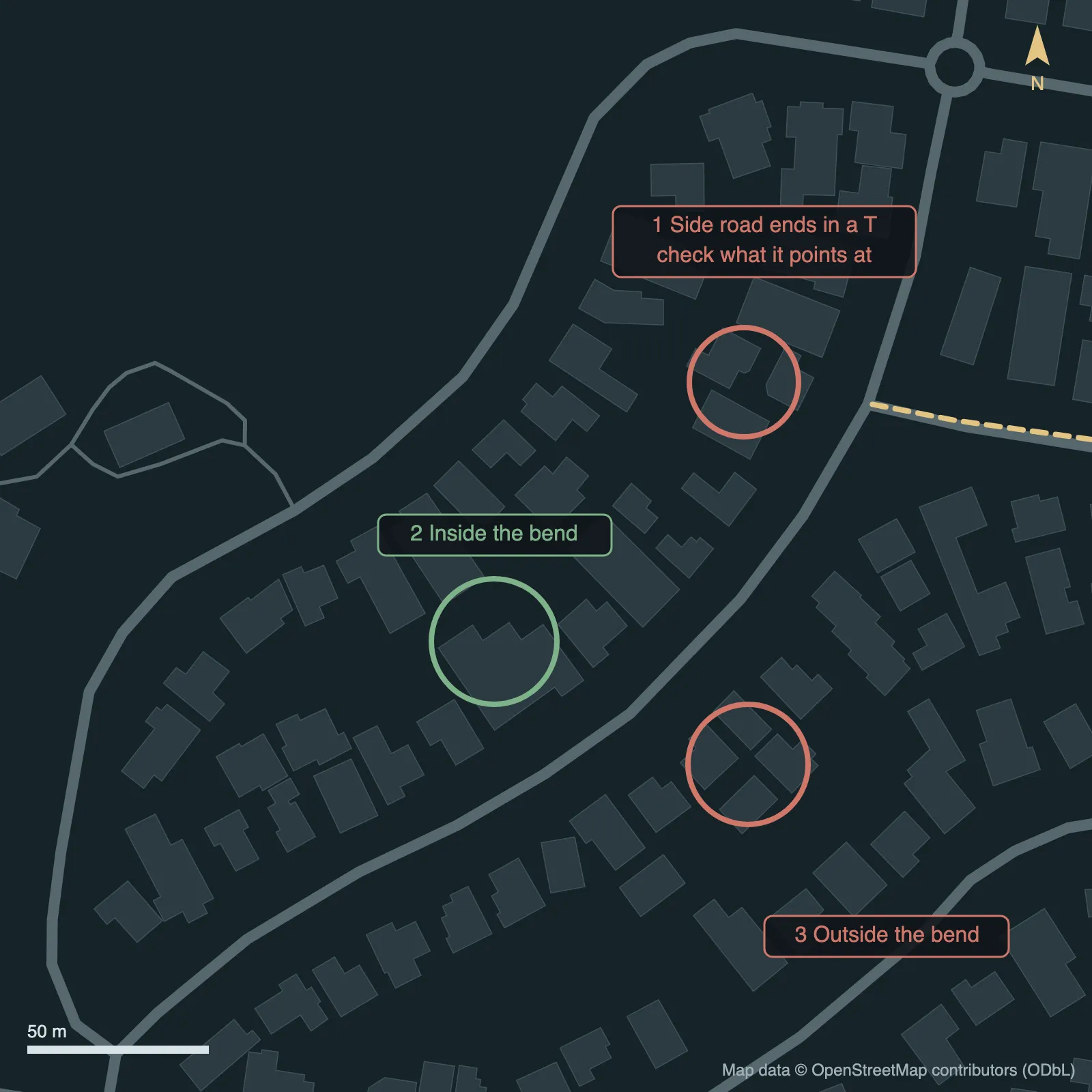
| Road aimed at the house 路冲 | Roads that pass alongside | A straight road or lane pointing at the door or windows | Map |
| Curve of the road or water 玉带 / 反弓 | Being on the inside of the bend | Being on the outside of the bend | Map |
| Front space 明堂 | Open but contained: a park, courtyard or calm water | A wall of buildings right in front, or open land with no edge | Map and site |
| Behind 靠山 | Something taller and solid behind | Nothing behind, or a drop-off | Map and site |
| Left and right 青龙白虎 | The left (facing out) slightly higher or busier than the right | A dominant building or slope on the right | Map and site |
| Sharp forms 煞 | Neighbouring buildings parallel to yours | A corner aimed at your windows; a narrow gap between towers facing you; an elevated road at window height | Map and site |
| Water | Calm water in front that embraces the site | Fast water or a channel aimed at the house | Map and site |
| Street-level conditions | Quiet approach, clear entrance | Heavy traffic, noise or a cramped entrance | On site |
On site: what the map cannot show
Bring a compass or a phone compass and stand well away from cars and metal railings. Take the facing reading from the front facade, not the door. Walk the approach and note the traffic, noise and how the entrance is reached. Check anything the satellite image hides: trees, walls, a lane between buildings, the height of the neighbour behind. Compare what you see with your screenshot.
Weighing the results
Few homes pass every item, and the classical texts weigh them differently. A road aimed straight at the main door and being on the outside of a curve are treated as the most serious; a slightly unbalanced left and right as minor. Many issues have traditional mitigations, such as screening with a wall or planting, or using a different entrance. If two homes are otherwise equal, the checklist is a reasonable tie-breaker.
Where the checklist stops
These are traditional readings, not findings about a home's value or about what will happen to the people living in it. Structural condition, flooding risk, the neighbourhood, schools, transport and price are the deciding facts in a purchase. Use the checklist alongside them, never instead of them.
FAQ
What is the most important feng shui check when buying a house?
In the classical form-school texts, a road or water channel aimed straight at the main door is one of the most serious cautions, followed by sitting on the outside of a curving road or river.
Can I check feng shui from Google Maps?
Most of the outside, yes: roads, curves, water, open space and neighbouring buildings. The facing direction, traffic and anything under tree cover still need to be confirmed on site.
Is a house at a T-junction always bad feng shui?
It is a classic caution, but the texts weigh it by how directly the road points at the door, how wide and busy it is, and what stands between. Our T-junction guide covers this in detail.
Does an apartment need the same checks?
Yes, at the level of the building and its surroundings. For a flat, also note which side your unit faces and whether anything is aimed at your windows at your floor's height.
Classical terms in this guide
Each term page quotes the original classical texts.
Sources and verification
Continue reading
- T-Junction House Feng Shui: Road Rush (路冲) Explained
- Reverse-Bow vs Jade-Belt Road: Which Side of the Curve
- Cul-de-sac House Feng Shui: Dead-End Streets Explained