T-Junction House Feng Shui: Road Rush (路冲) Explained
What feng shui says about a house at a T-junction or facing a straight road: what counts as road rush (路冲), what makes it stronger or weaker, how to spot it on a map, and the traditional ways of reducing it.
In brief
- ✦Road rush (路冲) is a straight road, lane or driveway that points directly at a house, most often at the top of a T-junction.
- ✦The classical texts read it as qi arriving too fast and too straight; the Qing manual Ba Zhai Ming Jing states that a street aimed straight at the door is unfavourable.
- ✦Severity depends on how squarely the road hits the door or windows, how wide and busy it is, how long the straight run is, and what stands in between.
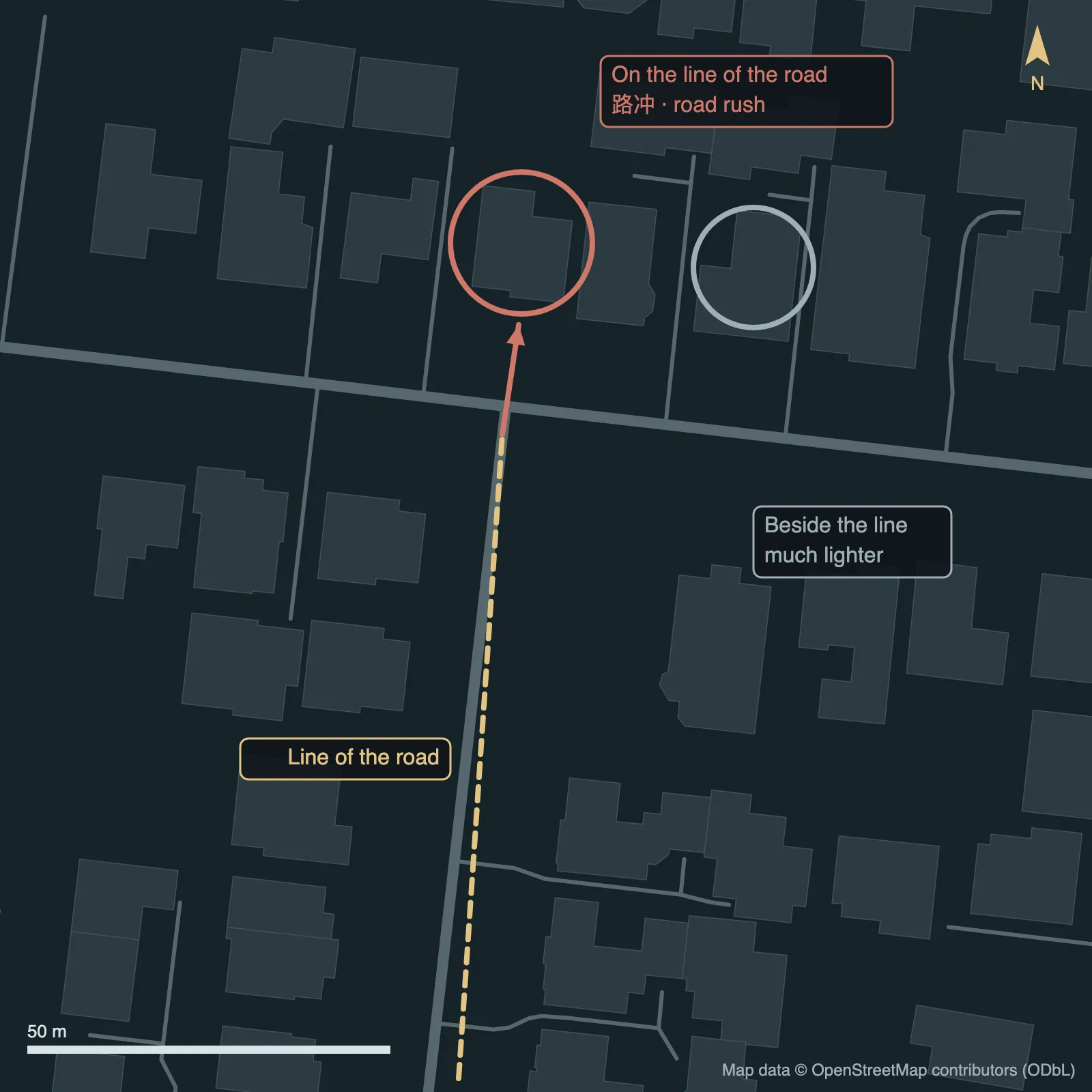
- ✦A house beside the end of the road, or with the road aimed at a blank wall, is read as much lighter than one with the road aimed at the main door.
- ✦Traditional responses are distance and screening, such as a wall, hedge or trees, or using an entrance that is off the line of the road.
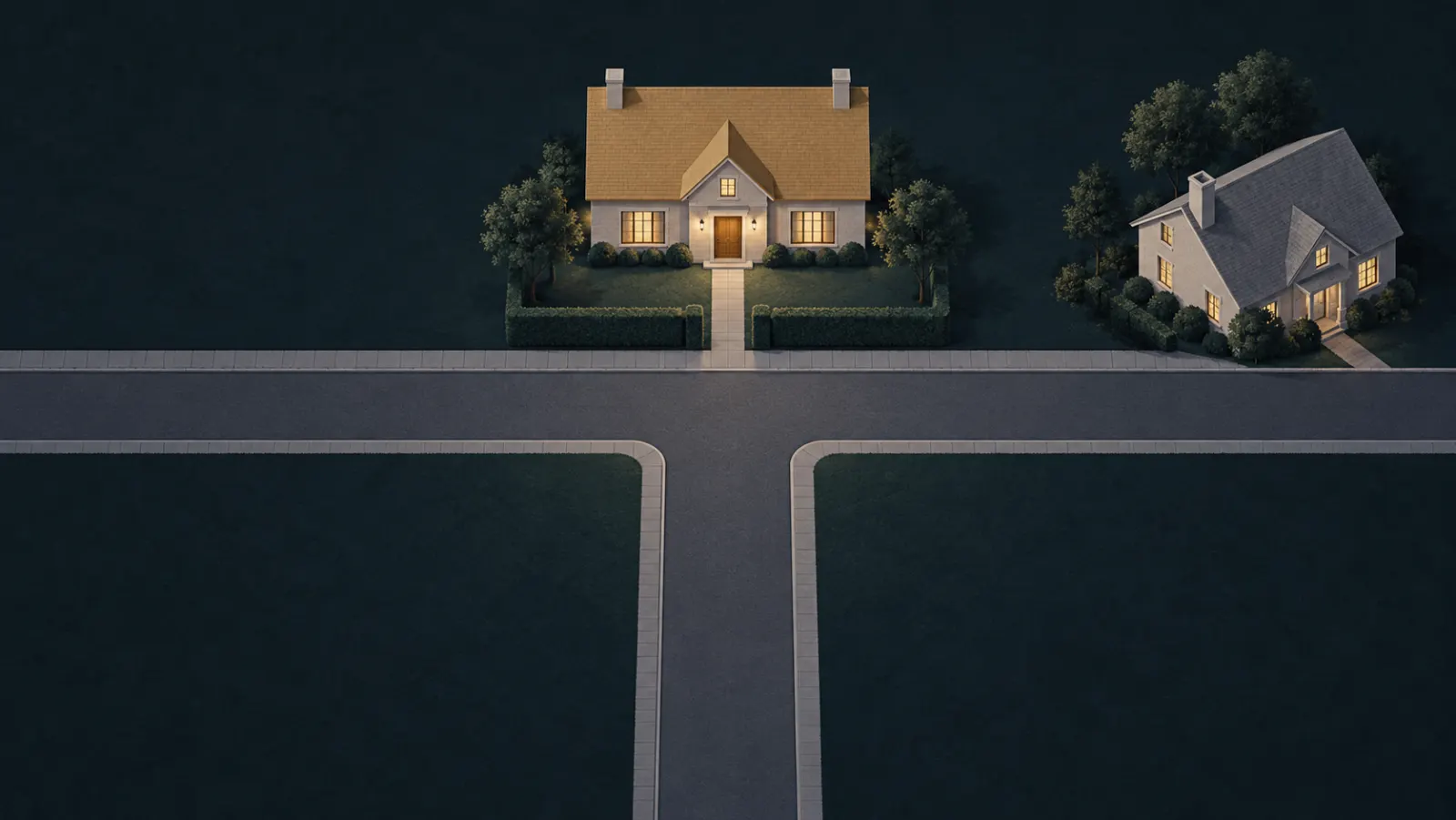
Where road rush falls at a T-junction
What counts as road rush
Road rush, 路冲 (lù chōng), is any straight road, lane, driveway or long corridor of open ground that runs directly at a building. The textbook case is the house at the top of a T-junction, with the stem of the T pointing at its front. The same reading applies to a house at the end of a straight cul-de-sac, a home facing the exit of a car park, or a unit whose windows look straight down a road. A road that curves past, or runs alongside, is not road rush.
What the classical texts say
The Qing residential manual Ba Zhai Ming Jing lists 'a street aimed straight at the door' among unfavourable features, next to 'a street that bows away like the back of a bow'. The Zhai Fa Ju Yu groups roads and waterways that strike the house under the same caution and says that any such thrust is to be avoided, whichever side it comes from. Behind both is the form-school idea that qi should arrive gently and gather; a straight, fast approach is read as qi that strikes rather than settles.
What makes it stronger or weaker
Traditional readers weigh road rush by degree rather than treating every T-junction the same. The table gives the factors they usually consider.
| Factor | Lighter | Heavier |
|---|---|---|
| Aim | Road points at a corner or blank wall | Road points squarely at the main door |
| Width and traffic | Narrow, quiet lane | Wide, busy road |
| Length of the straight run | Short, or bends before reaching you | Long and straight |
| Distance | Far, with front space in between | Close, ending at your boundary |
| Screening | Wall, hedge, trees or another building in between | Nothing in between |
| Height | Upper floors above the line of traffic | Ground floor at road level |
| Use of the building | Shop or business, where some readers see passing trade | Home, especially bedroom or front door on the line |
How to spot it on a map
In satellite view, find the building and draw an imaginary line straight back along each road that ends near it. If a line runs into the front door or the main windows, that is road rush; if it runs into the corner of the plot, a garage or a neighbour, it is much lighter. Check driveways and lanes as well as public roads. Then confirm on site where the door actually is and how much traffic the road carries.
Traditional ways of reducing it
The classical answers are physical: increase the distance, put something solid or green in between, and keep the main door and bedrooms off the line of the road. A wall, a dense hedge or a row of trees is the standard screen. Some households use an entrance on another side. Folk practice adds objects such as a Shi Gan Dang stone or a bagua mirror; these are customs rather than part of the form-school texts. None of them changes the traffic itself.
T-junction homes and buying decisions
In markets where many buyers follow feng shui, a T-junction position can make a home harder to sell later, which is worth weighing whoever you expect the next buyer to be. Headlights at night, noise and the small but real risk of a vehicle overrunning the junction are practical points worth checking on their own. The feng shui reading is one layer on top of those, not a substitute for them.
FAQ
Is a T-junction house bad feng shui?
It is one of the classic cautions in form-school feng shui. How serious it is depends on whether the road points at the main door, how wide and busy it is, and what stands in between.
What is the cure for a T-junction house?
The traditional answers are distance and screening: a wall, hedge or trees between the road and the house, and keeping the main door and bedrooms off the road's line. Mirrors and stones are folk customs on top of that.
Is a house at the end of a cul-de-sac road rush?
If a straight cul-de-sac points at the house, it is read the same way, usually lighter because traffic is low. A curved cul-de-sac that wraps around the house is read more favourably.
Does road rush affect apartments?
It is read by floor: a road aimed at your windows at your height matters more than one aimed at the lobby many floors below.
Classical terms in this guide
Each term page quotes the original classical texts.
Sources and verification
Continue reading
- Feng Shui House-Hunting Checklist: What to Check Outside
- Reverse-Bow vs Jade-Belt Road: Which Side of the Curve
- Cul-de-sac House Feng Shui: Dead-End Streets Explained