Reverse-Bow vs Jade-Belt Road: Which Side of the Curve
Feng shui for a house on a curved road or river: the jade-belt (玉带) position on the inside of the bend, the reverse-bow (反弓) position on the outside, what the classical texts say about each, and how to read a curve on a map.
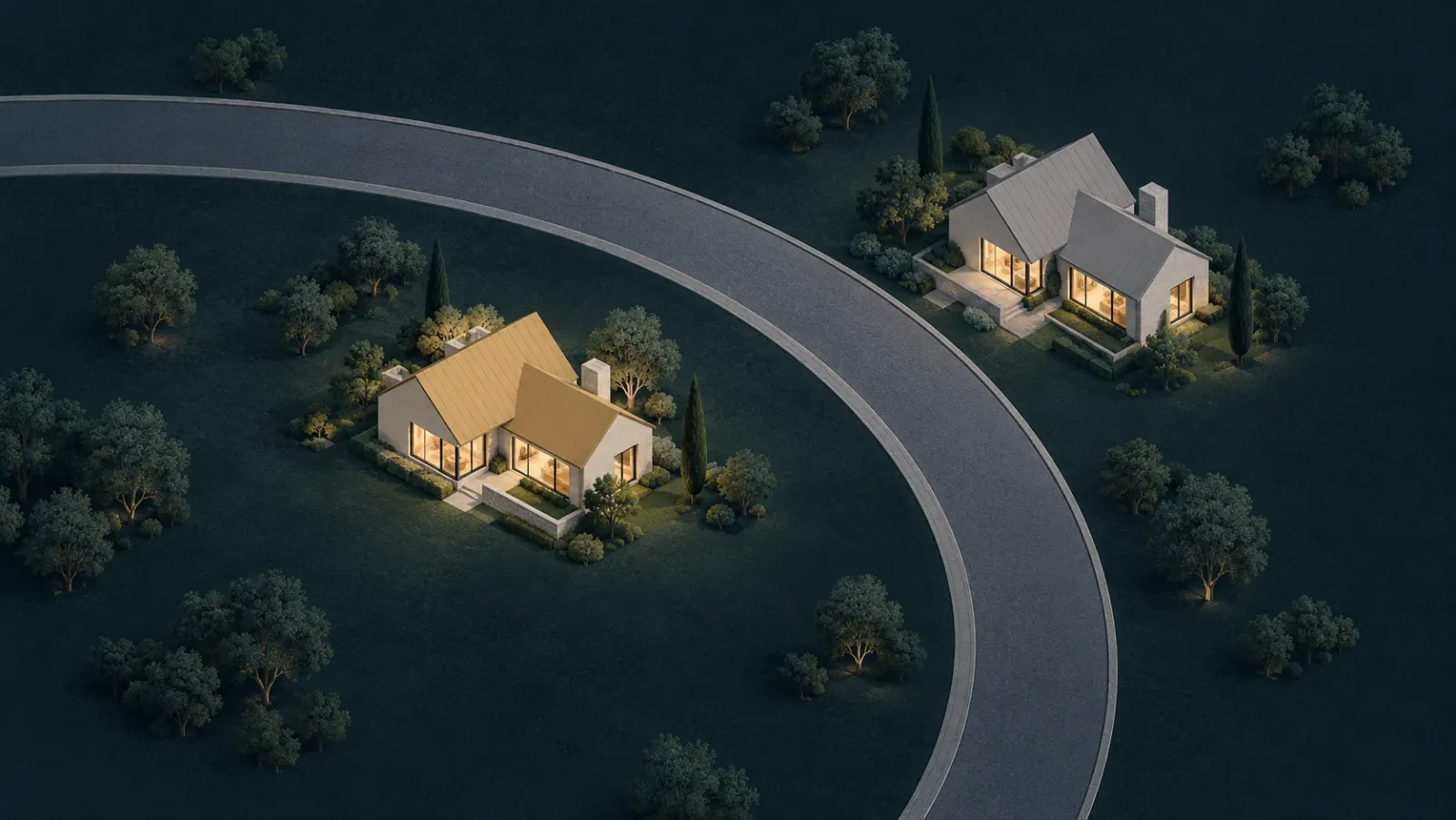
In brief
- ✦When a road or river curves past a house, form-school feng shui cares which side of the bend the house is on.
- ✦On the inside of the bend, wrapped by the curve, is the jade belt (玉带): read as favourable, a road or water that embraces the site.
- ✦On the outside of the bend, with the curve bowing away, is the reverse bow (反弓): read as unfavourable. The Qing Ba Zhai Ming Jing calls a street 'bowing out like the back of a bow' inauspicious.
- ✦The reading is strongest when the bend sits right in front of the house and the road or water is wide or busy.
- ✦Curves are easier to see from above than from the street, which makes this one of the most useful checks to do on a satellite map.
Inside and outside a curving road
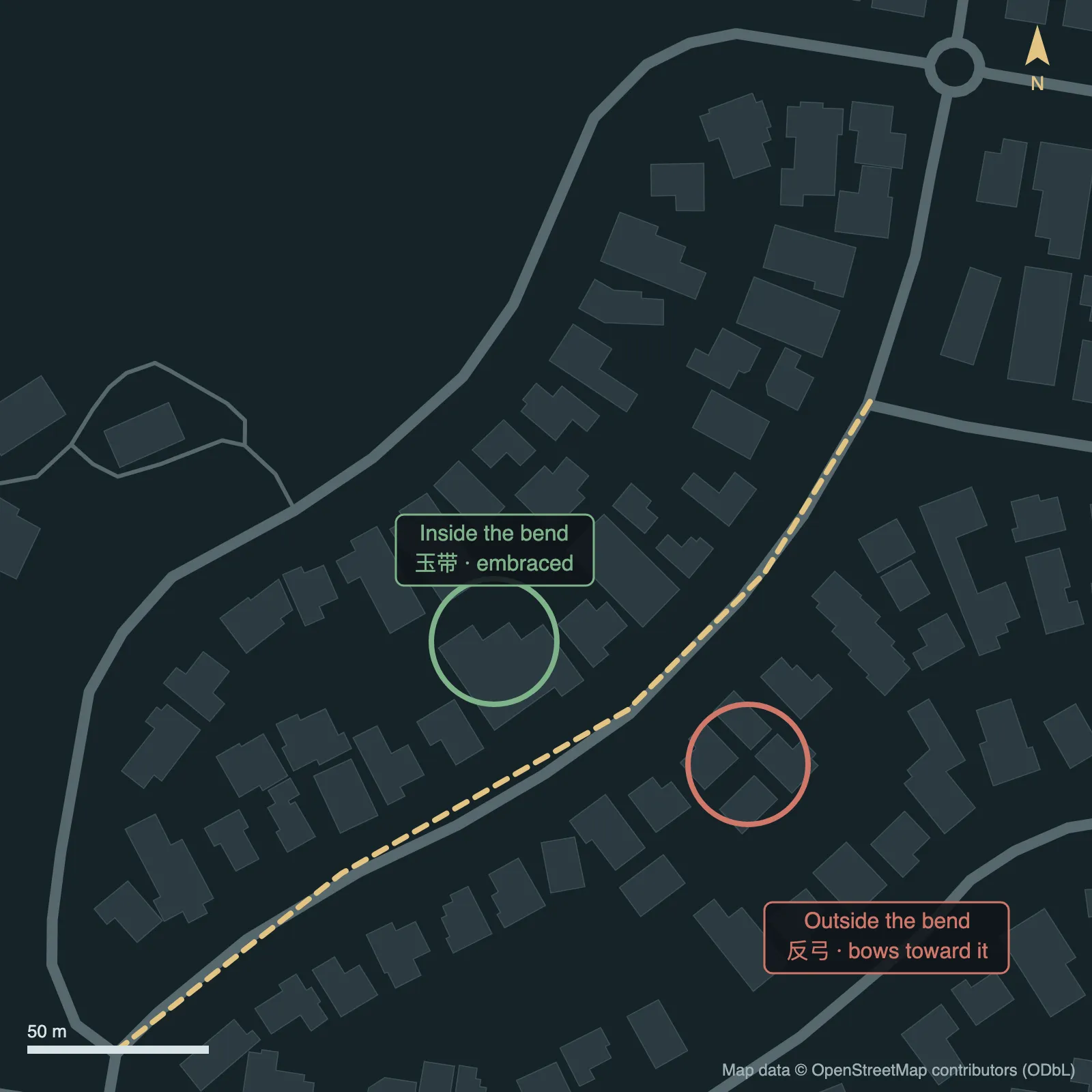
Two sides of the same curve
Any bend in a road or river has an inside and an outside. A house on the inside sits within the embrace of the curve, like a waist inside a belt; that is the jade-belt position, 玉带环腰. A house on the outside faces the convex side of the bend, which bows away from it like the back of a drawn bow; that is the reverse bow, 反弓. The two are mirror images, and the classical texts treat them as opposites.
What the classical texts say
The Han Long Jing, the Tang-attributed classic of form school, puts it in one line: what lies in front should curve like a drawn bow, which is good, while a reversed bow is bad. The Ba Zhai Ming Jing lists 'a street that bows out like the back of a bow' as inauspicious, and the Zhai Fa Ju Yu includes 'reverse bows and slanting flights' among the water and road forms it calls unfavourable. On the favourable side, the Ming Yang Zhai Shi Shu says that jade-belt water in front of the gate brings officials and scholars to the family. Behind all of them is the idea that an embracing curve gathers qi and a curve that bows away lets it scatter.
Reading a curve: the table
Traditional readers weigh the curve by position and scale. The table summarises the usual distinctions.
| Feature | Jade belt (inside) | Reverse bow (outside) |
|---|---|---|
| Position | House within the curve | House facing the convex side |
| Classical reading | Embraces and gathers qi | Bows away and scatters qi; read as a blade facing the house |
| Strongest when | The curve wraps the front of the house | The outer edge of the bend points at the front door |
| Weaker when | The curve is far away or behind the house | Screened by buildings, walls or trees, or far away |
| Water vs road | Calm, slow water is valued most | Fast water or a busy road on the outside of a bend is read as the most serious |
How to check it on a map
Open the address in satellite view and zoom out until you can see where the road or river bends. Draw an imaginary arc along it. If your building sits in the hollow of the arc, you are on the jade-belt side; if the arc bulges toward you, you are on the reverse-bow side. Check rivers, canals, highways and on-ramps as well as streets. A gentle curve two blocks away matters far less than a sharp bend at your front boundary.
Traditional ways of reducing a reverse bow
As with road rush, the classical answers are distance and screening: a solid wall, hedge or line of trees between the house and the outer edge of the bend, and keeping the main door and bedrooms off the side that faces it. Some households use an entrance on a side that faces away from the bend. Mirrors and other objects are folk additions rather than part of the form-school texts.
Using the reading sensibly
A house on the outside of a bend can still be a good home, and a jade-belt position does not make a poor house good. On busy roads, the outside of a curve also has practical points of its own, such as headlights sweeping across windows and vehicles that run wide. Treat the classical reading as one layer, and check the practical ones directly.
FAQ
What is a reverse bow road in feng shui?
A road or river that curves past a house with the house on the outside of the bend, so the curve bows away from it. Classical texts read it as unfavourable.
What is jade belt water?
Water or a road that curves around a house with the house on the inside of the bend, wrapped like a waist in a belt. It is one of the most favourable features in form-school texts.
Does a curved driveway count?
Readers apply the same idea at smaller scale, but the classical texts weigh roads and waterways most. A short private driveway is a minor factor.
Is a reverse bow worse with water or with a road?
The texts discuss both. Fast water and busy roads on the outside of a bend are read as the most serious cases.
Classical terms in this guide
Each term page quotes the original classical texts.
Sources and verification
- 撼龍經 (attrib. Yang Junsong): 'curved like a drawn bow is good; a reversed bow is bad' — full text, Daizhige
- 八宅明鏡 (Qing): 'a street bowing away like the back of a bow is unfavourable' — full text
- 宅法舉隅 (Qing): 外六事總論, water, roads and neighbouring buildings — full text, Daizhige
- 陽宅十書 (Ming, Wang Junrong): 論宅外形, the outside forms of a house — full text
Continue reading
- Feng Shui House-Hunting Checklist: What to Check Outside
- T-Junction House Feng Shui: Road Rush (路冲) Explained
- Cul-de-sac House Feng Shui: Dead-End Streets Explained