Tall Buildings and Sha Qi: Sharp Corners, Gaps and Overpasses
Feng shui of the buildings around a home: what sha qi (煞气) means, the sharp corner (尖角煞), the gap between towers (天斩煞), elevated roads (镰刀煞), oppressive tall buildings, and what the classical texts say about neighbouring buildings.
In brief
- ✦Sha (煞) is the feng shui term for a hostile form aimed at a house; around modern homes it mostly comes from neighbouring buildings and roads.
- ✦The Qing Zhai Fa Ju Yu warns that a neighbouring building that rises high, or a ridge or wall pointing at the door, brings harm even when screened, naming 'pressing the head' and 'striking the chest' forms.
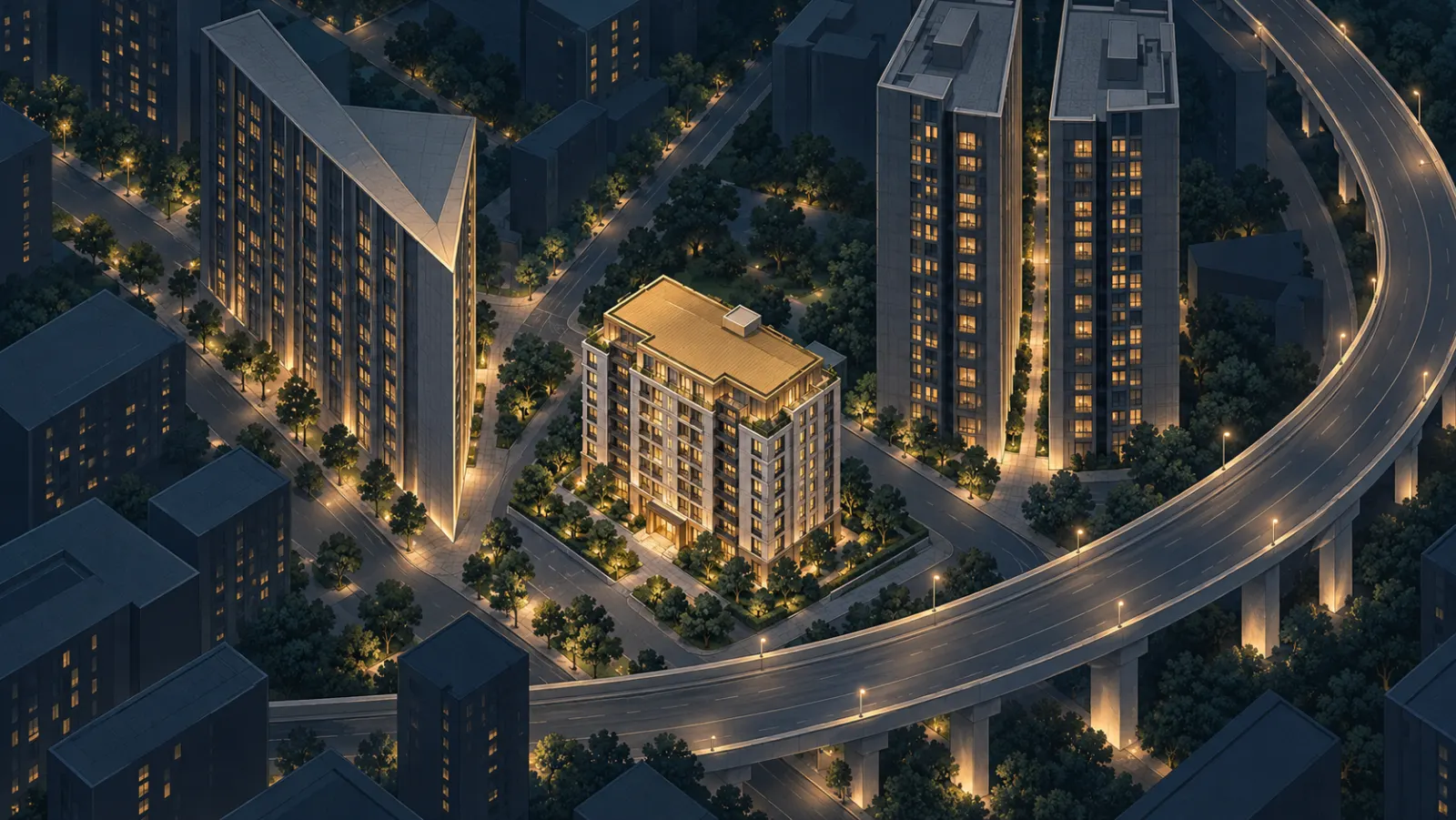
- ✦Common modern names are the sharp corner (尖角煞), the narrow gap between two towers (天斩煞) and the elevated road sweeping past (镰刀煞); they apply classical principles to city forms.
- ✦A tall building directly behind is usually read as support; the same building directly in front, close and overbearing, is read as pressure.
- ✦Distance, angle and what stands between decide how much weight any of these carries.
Three common city forms of sha
What sha means
Sha, 煞, is qi that arrives in a hostile way: aimed, sharp, fast or overbearing. Road rush and the reverse bow are forms of sha from roads and water. In cities, most sha comes from other buildings: their corners, the gaps between them, their height and the roads raised between them. The classical texts discuss neighbouring buildings directly, and modern practice has given names to the forms that dense cities create.
What the classical texts say about neighbours
The Zhai Fa Ju Yu's survey of the outside of a house warns that when a neighbouring building rises high on any side, or a straight roof ridge or wall points at the door, harm follows even if something screens it, and it names the forms in front 'pressing the head', 'striking the chest', 'piercing the heart' and 'attacking the feet'. The Yang Zhai Shi Shu cautions against a tower rising on the White Tiger side and says that the corner of a house should not jut into the street. The texts' concern is consistent: buildings that loom over, point at or cut toward a house.
The common forms
The table lists the forms most often discussed for city homes. The Chinese names are mostly modern labels; the principles behind them are classical.
| Form | What it looks like | How it is read | Lighter when |
|---|---|---|---|
| Sharp corner 尖角煞 | The corner of a neighbouring building points at your windows or door | A blade aimed at the house | Far away, at a different height, or screened |
| Gap between towers 天斩煞 | A narrow slot between two tall buildings faces your home | Wind and qi forced through a cut | The gap is wide, or not aligned with you |
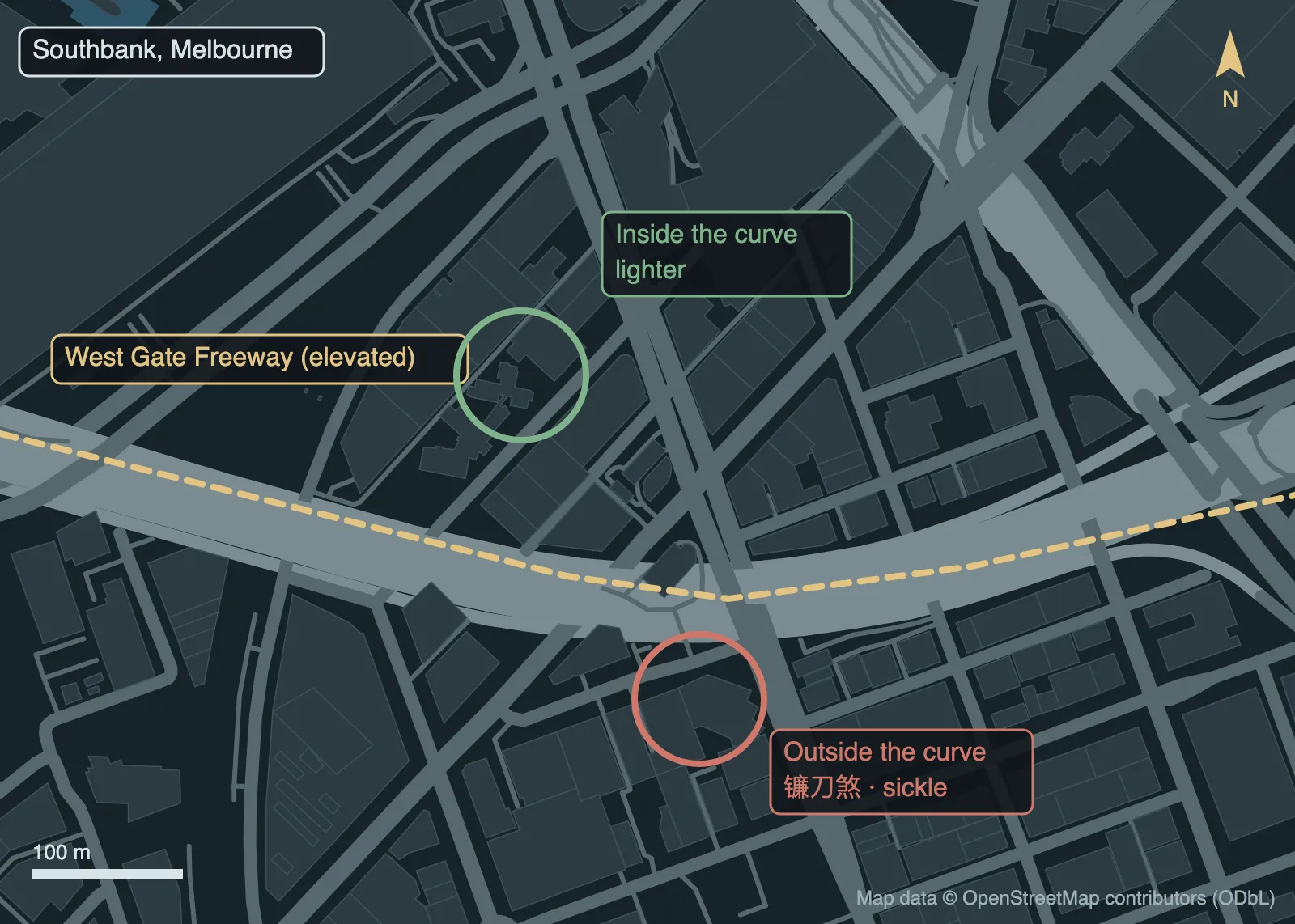
| Elevated road 镰刀煞 | An overpass or raised highway curves past at window height | A sickle sweeping past; worst on the outside of its curve | Far away, or below your floor |
| Overbearing building in front 压顶 | A much taller building close in front | Pressure on the house; a cramped bright hall | There is open space between |
| Tall building behind 靠山 | A taller, solid building directly behind | Usually read as support | Not a caution unless it leans over or points at you |
| Tall building on the right 白虎抬头 | A dominant building on the right as you face out | The White Tiger overpowering the Dragon | The left side is equal or higher |
Front, back and sides
Position changes the reading of the same building. Behind a house, a taller, solid neighbour is the backing mountain and is read as support. In front, close and taller, it presses on the house and fills the space where qi should gather. On the left, facing out, a slightly higher neighbour is acceptable; on the right, a dominant one is a classic caution. When you read any of these, also note the floor you are on: a corner aimed at the tenth floor does not affect the second.
How to check on a map and on site
Satellite view shows corners, gaps and elevated roads clearly from above; 3D view or street view shows heights. For a flat, stand at your own windows during the viewing and look at what each one faces. Note anything pointed straight at a window or the door, any slot between towers lined up with you, and any raised road at your height. Then judge distance: a corner across a park matters far less than one across a lane.
Traditional responses and their limits
The classical answers are the same as for other sha: distance, screening with planting or solid structures, and keeping the main door and bedrooms away from the side that faces the form. Curtains and frosted glass are practical versions for flats. Mirrors and figurines are folk additions. None of this changes noise, shading or wind between towers, which are worth checking for their own sake.
FAQ
What is sha qi in feng shui?
Qi that arrives in a hostile way: aimed, sharp, fast or overbearing. Around modern homes it mostly comes from neighbouring buildings and roads.
Is a tall building in front of my home bad feng shui?
If it is close and much taller, traditional readers see it as pressing on the house and crowding the space in front. With open space between, it is read much more lightly.
Is a tall building behind my home bad?
Usually the opposite: a taller, solid building behind is read as the backing mountain that supports a house.
Does a sharp corner affect an apartment on a high floor?
Only if it points at your floor. Readers judge sha at the height of the unit, not at street level.
Classical terms in this guide
Each term page quotes the original classical texts.
Sources and verification
Continue reading
- Feng Shui House-Hunting Checklist: What to Check Outside
- T-Junction House Feng Shui: Road Rush (路冲) Explained
- Reverse-Bow vs Jade-Belt Road: Which Side of the Curve